
New York Property Search Steps
A New York property search rarely ends at one desk. Assessors keep the local rolls. County clerks hold most deed records. The five boroughs run their own systems. A statewide lookup is really a matter of finding the right office. Start with whatever you have. That might be an address, an owner name, or a parcel number. From there, you can search New York property records by county. Compare the dated assessment entry against the recorded deed. One caution: a mailing city can point to the wrong jurisdiction. Always anchor the search to the parcel's actual town or county.
- Find the county and assessing city, town, or village through the state’s Municipal Data Portal or local roll route.
- Search the official parcel address in a local roll or GIS, then copy the SWIS and print key or SBL exactly as shown.
- Use the parcel key to locate the assessment row; read its roll year, owner fields, property class, and value fields.
- Search the transfer source and county recording index by address, parcel key, buyer or seller name, and document reference.
- Compare dates and legal descriptions. Ask the custodian for an image or copy when an index result is not the underlying document.
In most counties the assessor and the county clerk are separate offices with separate indexes. This route uses the local record to confirm any statewide result. It also leaves you with a clean parcel number if an online property search ends without an image.
New York Search Starts at Local Rolls
The New York State Municipal Data Portal is a directory, not a parcel database. It connects you to whoever keeps the records locally. In Municipal Profiles, pick a county, then a municipality, or use the search control. Profiles list local contacts, roll dates, equalization-rate material, and school-district context. The local roll instructions lay out the next step: choose the county, the city, town, or village. Then open Local Officials Addresses. Follow the municipal roll link. No roll posted? Check the county site.
One more wrinkle exists. ORPTS launched a newer Profiles, Sales Web, and Rates platform in June 2025. Older bookmarks may not match the live controls. A postal city can also differ from the assessor's municipality. A village, town, school district, and county can each appear in separate roll or bill contexts. Carry the jurisdiction printed on the record into every later search.
Use the Municipal Profiles county and municipality route to identify the local custodian. Do this before anything else.
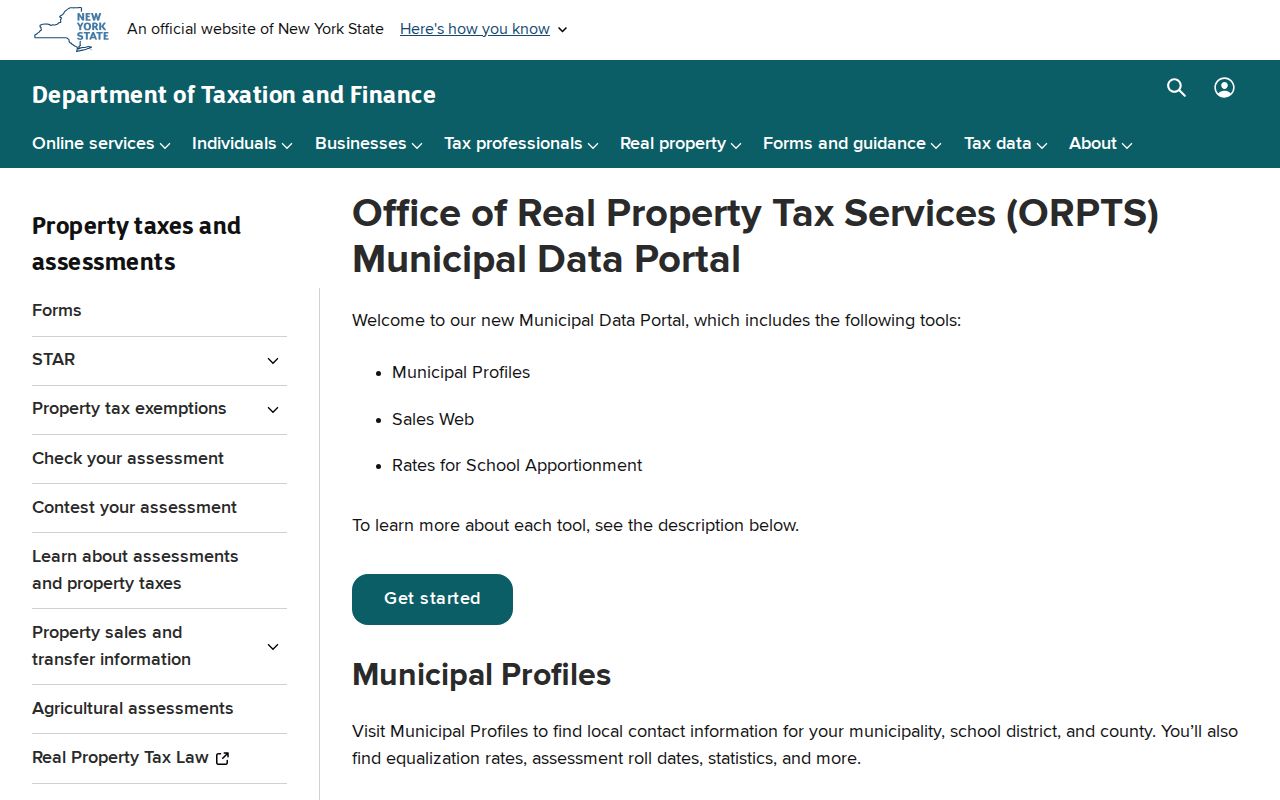
Going county-first prevents a false match. A postal place name and the government that keeps the assessment record are not always the same thing, and the county route settles the question.
New York Roll Search Uses Parcel Keys
Final-roll records from 996 local governments outside New York City feed the state Open Data assessment dataset. Think of it as a statewide lens for property records. It is useful for discovery and comparison across counties. But it is never the last word. Verification belongs to the local roll. NYC parcels sit outside its scope. The dataset carries county, municipality, school district, SWIS, roll year, and property class. It also includes print key, parcel address, owner and mailing fields, exemptions, assessment, and taxable values.
Always carry the county and municipality alongside the parcel key. Pairing SWIS with the print key links a parcel across the roll, GIS map, and Sales Web. Local formats differ, though. For a blank or unfamiliar value, consult the state's data dictionary. It defines the codes, including roll sections. Guessing is how deed records get mismatched.
| Search Field | Where It Appears | How It Helps |
|---|---|---|
| County and municipality | Municipal Profiles; Open Data | Routes the search to the assessing jurisdiction. |
| Roll year and school district | Open Data final-roll row | Dates the record and separates local tax contexts. |
| SWIS and print key | Assessment roll; GIS; Sales Web | Links a parcel across systems; preserve punctuation. |
| Parcel address and owner fields | Open Data final-roll row | Finds a row when the parcel key is not yet known. |
| Buyer or seller name | Sales Web | Finds reported transfers by one party at a time. |
| Street address, book/page, or tax-map ID | Sales Web | Searches a reported transfer using a location or recording reference. |
Read the catalog's scope and update date before relying on a match. Local submissions can be incomplete or later corrected, and the file holds final rolls rather than live bills. The dataset page describes the coverage, but the local assessor still gets the final word.
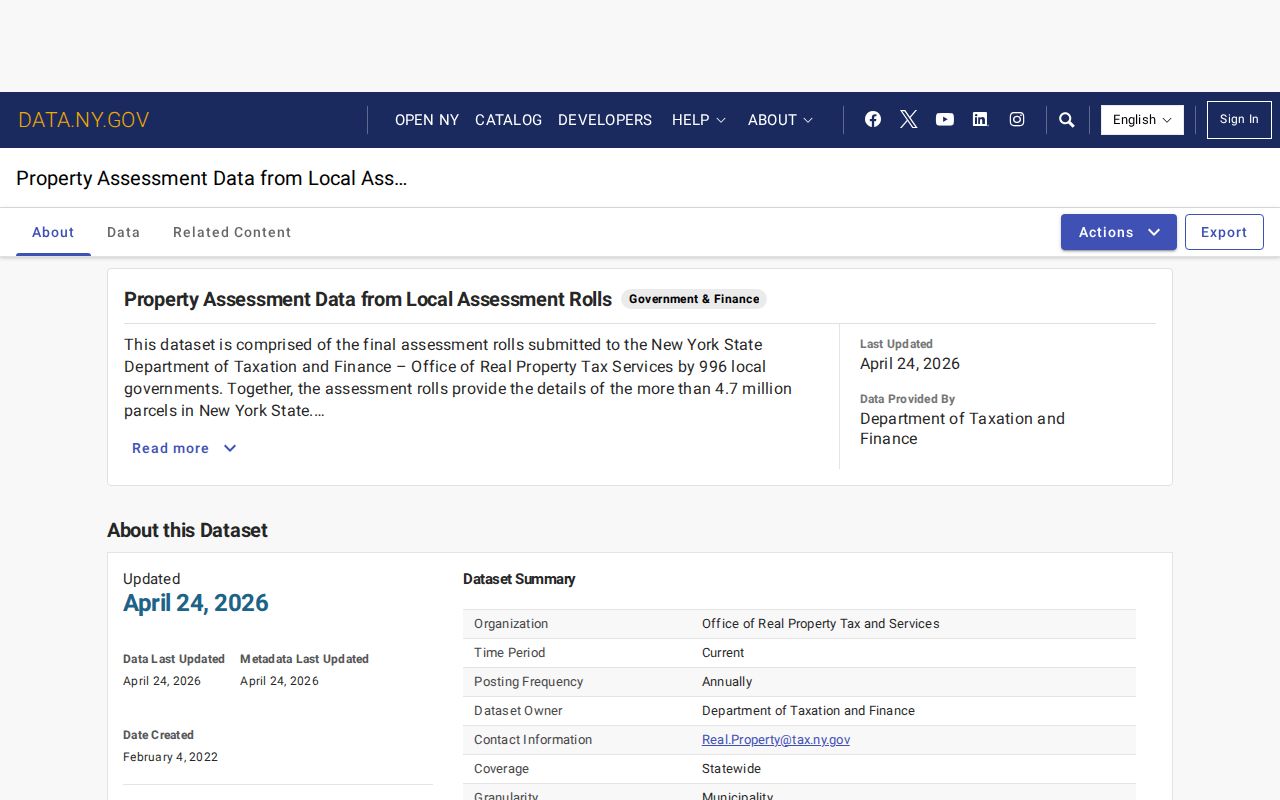
A matching row is only a lead to the local assessment record. Save the roll year, municipality, SWIS, and print key with the result.
New York Property Search Uses Sales Web
Sales Web covers sales and transfers for up to ten years outside New York City. Search by buyer or seller, street address, deed book and page, or tax-map ID. You can group results by state, county, municipality, or school district. Local offices transmit weekly. A transfer can still lag by weeks or months. So the feed is not a complete deed index.
Queries cap at 3,000 results and can time out after 15 minutes. Output comes as text, Excel, or InfoMaker. The state excludes co-op transfers, easements, rights-of-way, mineral rights, and individual cemetery plots. So a blank result may reflect an exclusion rather than a missing deed. The Sales Web instructions describe the search and download options. Older transfers belong with the county clerk. NYC uses its own borough routes.
What a New York Property Record Returns
No single search returns a complete property card. A final-roll row carries the roll year, jurisdiction, SWIS, class, print key, address, owner and mailing fields, exemptions, and assessed and taxable values. A GIS map may add the parcel shape. A transfer result can show the parties, the deed reference, and the sale or recording dates.
| Record Field | What It Shows |
|---|---|
| County, municipality, SWIS | The local jurisdiction attached to the assessment row. |
| Roll year and property class | The year and class used to read assessment fields. |
| Print key or SBL | The local parcel identifier, with punctuation that may vary by office. |
| Parcel address | Location fields recorded for the assessed parcel. |
| Owner and additional-owner fields | Names as submitted for that roll, not a guaranteed current title holder. |
| Mailing address | Where assessment correspondence is routed, which may differ from the parcel address. |
| Assessment, full value, exemptions | Separate valuation and tax-base fields that need the roll year and code definitions. |
| Buyer/seller, deed date, book/page | Transfer details reported in Sales Web, subject to feed timing and exclusions. |
Never treat a roll name or mailing address as proof of residence or current title. The roll and the transfer feed carry different dates. An index row is not the recorded instrument. Check the roll section and property class before comparing values. The dictionary separates ordinary taxable parcels from special-franchise, state-land, railroad, utility, and exempt entries. Full market value, total assessment, and county, town, or school taxable values each sit in their own fields.
New York Search Needs the Taxing Place
The mailing city on an envelope rarely tells you who taxes the land. One address can fall under a town, a village, a school district, the county, and a special district all at once. Each layer keeps its own roll or bill. That is why the municipality named on the assessment record, together with its SWIS code, beats the postal city as a guide. Copy both before you search further.
Some municipalities carry more than one SWIS code. The state's local-roll instructions are clear here: pick the city, town, or village option matching the parcel. Where several codes are listed, use the TOV choice. Save that jurisdiction alongside the print key. Keeping the two together ties a later owner, transfer, or map result to the right parcel, not to a nearby place with a confusingly similar name.
New York City Uses Borough Parcel Keys
New York City sits outside the state assessment dataset. Manhattan, the Bronx, Brooklyn, and Queens work differently. Record the borough-block-lot, the BBL, for each parcel. Property data comes from the Department of Finance. Documents come from ACRIS, which covers those four boroughs from 1966 forward and searches by party, BBL, document type, document ID or CRFN, transaction number, reel/page, and certain lien-file numbers.
Hold onto the BBL and every result's own identifier. An ACRIS record can show parties, parcels, references, remarks, and image links, which an upstate book/page index does not offer. For pre-1966 records, turn to the Land Records Research Library. Richmond County, covering Staten Island, stays with the Richmond County Clerk. Field definitions are in the ACRIS search help.
New York Property Search and Local Permits
Do not expect a parcel search to return a building history. New York has no single statewide public permit search. Permits, inspections, certificates of occupancy, complaints, and violations usually sit with a local office. That office is the local building or code-enforcement department. A local system may search by address, parcel, permit number, or another local key. Older records may need an office visit or a records request.
New York City shows how sharp the split can be. The city's BIS and DOB NOW are separate systems. DOB NOW jobs never appear in BIS. The city advises checking both and using the BIN when available. Elsewhere, contact the city, town, or village building department named in the local directory. The state building-code administration page describes local permit and inspection records. The DOB NOW FAQ explains where the NYC system boundary falls.
New York County Indexes Search by Party
Outside the four ACRIS boroughs, county clerks record deeds and related instruments. The NYS Land Records portal routes you to participating county systems. It does not offer one uniform statewide party search. County forms differ. Date coverage differs too, and some counties index by grantor and grantee instead of address.
Read the county coverage note first. Then try the exact parcel key, a party-name variation, and the right document group. When the online index ends, a counter request or a written one can help. It can reach older records or images. Keep the clerk reference and your query for later.
New York Search Needs Four Dates
Four dates belong in every search log. Note the roll or status date. Note the deed recording date, the source update date, and the day you searched. A later transfer can post after the roll snapshot was taken. Sales Web may lag local submissions by weeks or even months.
If the online trail runs cold, go to the clerk's index or book room. Use the Archives real-property pathfinder for historic series. FOIL requests records that already exist at a state or local agency. It does not build a parcel report. Courts follow the clerk route or the court search. Carry your query, the coverage note, and the parcel key to the next custodian. For the address-to-parcel route in general, the New York deed-record search continues from the owner or parcel key. It reaches the recorded instrument.
New York Search by Address, Owner, Parcel
Start with what you know. An unfamiliar address calls for the local roll or map first. Then copy the parcel identifier. A known owner means comparing the roll name with the county or ACRIS party form. A known key demands care. Preserve letters, zeroes, dots, and dashes exactly. Verify the jurisdiction before touching the format.
Addresses make fragile locators. Street spelling varies. Some parcels lack a conventional situs address. The mailing city may not match the assessing municipality at all. Try the roll's official address and a normalized form. Then carry the SWIS and print key forward. Search a name in the order the source itself uses it. A common name or a shared mailing address never establishes identity.
| Search Key | Best Use | Where It Works | Limit to Check |
|---|---|---|---|
| Address | Find a likely parcel from a known location. | Municipal roll, county or local GIS, Sales Web. | Postal city, street spelling, and numbering may not identify the assessing municipality. |
| Owner or party name | Find roll entries or reported transfers tied to a person or entity. | Open Data fields, Sales Web, county index, or ACRIS. | Try the source’s name order and exact entity name; a match alone does not establish identity or title. |
| Parcel key | Carry one parcel between assessment, map, transfer, and deed sources. | SWIS plus print key/SBL; BBL in four NYC boroughs. | Local formats vary, and parcels can split, merge, or receive a new key. |
- Parcel or SBL
- A taxing jurisdiction’s parcel identifier. New York formats vary; copy the exact print key or SBL and keep its SWIS context.
- APN
- A generic label for an assessor parcel number. New York offices may instead say SBL, tax-map ID, or print key, so use the local field name and format.
- SWIS
- A state code for the county and local assessing jurisdiction, useful for separating places with similar names.
- Situs address
- The location assigned to the parcel. It can differ from the owner’s mailing address.
- Owner of record
- The name shown in a particular record and as of that record’s date, not a title opinion.
A records search is not a title search. Assessment data, a map, and an index result each answer a limited question. Read the recorded instrument and its legal description for a conveyance; a title professional is needed for a title conclusion.