
Finding a New York Property Owner
Jurisdiction comes first. Pin the county and the assessing municipality before touching any database, then carry the SWIS and print key, or SBL, into the next source. Never trust one name field alone. A postal city can differ from the municipality that keeps the roll, so let the local record settle the question. The roll names the right jurisdiction.
- Identify the county and municipality in the Municipal Data Portal or official GIS. Keep the SWIS and parcel key with the address.
- Use the local assessment roll to read the owner name, additional owner fields, mailing address, roll year, and taxable-status date.
- Search a transfer source for a later event: Sales Web outside New York City, or ACRIS for Manhattan, Bronx, Brooklyn, and Queens.
- Confirm the party, capacity, parcel description, and recording date in the latest relevant deed from the county clerk or the correct city recording office.
Each source has its own job. The roll reports an assessment record. A transfer feed is only a lead. The deed remains the recorded instrument that actually conveys the parcel. Searching by an owner name still demands the parcel number and legal description before you can tie a name to the right New York property.
Compare New York Ownership Sources by Date
Every New York ownership source speaks with a different date. The roll answers for the taxable-status date. Its owner and mailing fields reflect that moment. A transfer feed can flag a recent transaction, but the county clerk's deed, or the city's recording system, supplies the instrument you must check against the parcel.
| Source | Ownership Detail | Date or Scope |
|---|---|---|
| Local assessment roll, reached through NYS local roll instructions | Owner and mailing fields tied to the parcel | Roll year and taxable-status date; local details vary |
| NYS Open Data assessment rolls | Submitted final-roll owner, address, and parcel fields | Local final rolls outside New York City |
| Sales Web | Reported buyer and seller transfer information | Ten-year window outside NYC; weekly feed can lag several weeks or months |
| County clerk index or ACRIS | Recorded parties, instrument, and parcel references | County coverage varies; ACRIS generally covers four boroughs from 1966 |
| NYS DOS entity database | Organization, status, and service-of-process information | Describes an entity, not whether it owns a parcel now |
The assessment dataset catalog spells out its final-roll scope along with its owner and mailing fields. New York City, though, runs on a separate data environment.
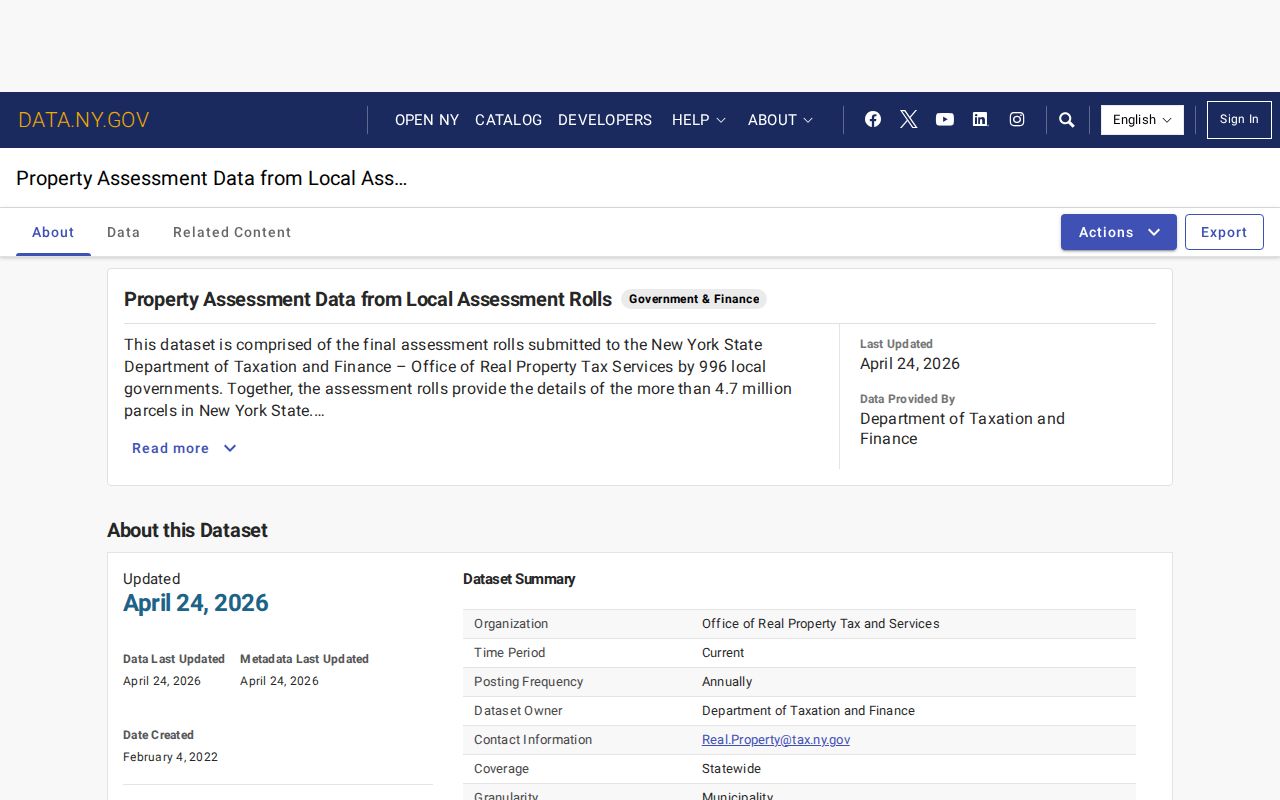
The catalog page itself lists the dataset's scope. A row can name the owner and mailing address reported for a roll year. It cannot tell you whether a newer deed changed the record.
Treat the statewide assessment dataset as a discovery layer, not a consolidated owner registry. It excludes New York City. It reflects local submissions. The ORPTS owner-date opinion explains why a roll can keep the prior name when a transfer follows the taxable-status date. The parcel still needs its deed and dates.
New York Transfers Lead to Deeds
Sales Web carries ten years of transfers outside New York City. Local submissions arrive weekly. Even so, a result can trail a closing by weeks or months. Treat it as a lead. It is not the deed. A blank result can mean lag, an excluded transfer type, or a parcel-key mismatch, so compare buyer, seller, municipality, tax-map key, and deed date against the roll. Then get the deed from the recording office.
Check a New York Deed by Parcel
Outside New York City, county clerks hold the deeds. The NYS Land Records portal routes you to participating county systems. It is not one uniform party-name index. A county may offer an online index, document images, an office terminal, or a written copy request. It may also mix those channels. Check every detail. Legal description, grantor and grantee, capacity, date, and book/page or instrument number must all match. Each of those points must line up with the parcel. A deed documents a conveyance, not a complete title opinion. The Archives' real-property pathfinder helps locate older series. Meanwhile, New York Deed Records covers the access steps.
New York City Ownership Follows the Borough
ACRIS serves Manhattan, Bronx, Brooklyn, and Queens. Recorded documents run from 1966 forward. Search with borough and block and lot identifiers as well as any party name. Older city instruments follow a different route. The New York City land-record instructions point researchers to the Land Records Research Library and borough-office routes. Richmond, or Staten Island, uses the Richmond County Clerk. Check borough, identifier, and date coverage before reading a blank result as proof that no transfer occurred.
Check New York Entity Names
Rolls and deeds often name entities. An LLC, corporation, trust, estate, trustee, or executor can appear where you expect a person. The registered-agent field never settles ownership. A DOS entity result shows the organization name, date, jurisdiction, status, service-of-process address, and registered agent. Some older or inactive histories stay incomplete. Use the result to read the name and capacity in the deed for the same parcel. Estates take one more step. The NYS Courts records guide points to the county Surrogate's Court clerk, where a probate docket explains authority and the fiduciary deed records the property transfer.
New York Deed Alerts Are Local
New York keeps deed alerts local. No single statewide service covers every county. The Attorney General’s deed-theft guidance tells owners to check official clerk or register records and to save instrument details whenever a document looks wrong. Any alert subscription comes from the local recording office, since availability differs county to county.
New York City takes a different route with an ACRIS recorded-document notification option. A notice is only a prompt to pull the instrument itself, never proof of fraud or a title problem. Save the CRFN or book and page, the date, the image, and the parcel number.
New York Postal Cities Misroute Rolls
A mailing city on an envelope rarely settles which municipality assesses a parcel. In New York a property can sit in a town or village. The postal address may name a nearby city instead. School, village, and tax districts layer on more labels. Follow the county-first Municipal Data Portal route to find the assessor. Record the municipality exactly as the tax roll prints it.
SWIS and print key join a map, roll, and transfer record far better than a postal locality. The code encodes county, town or city, and village parts. Keep leading zeroes and local punctuation intact. This geography check often clears a no-result before another name search. It is a quick step.
The lesson is simple: search by jurisdiction, not by mailing city.
Protecting a New York Owner’s Address
In New York, owner fields support parcel research only. They do not build a profile of a person. Keep notes limited to the parcel, record type, source, and date. An assessment mailing address is not proof that anyone lives at the property. Unrelated personal details should never be combined to guess at a home or household.
The New York Address Confidentiality Program gives eligible participants a substitute Albany mailing address. It applies to covered government records. Membership does not erase older public records. Respect the substitute address and use the official program route. Do not try to identify a protected location.
Requesting a New York Ownership Record
When a county roll or clerk index sits offline, contact the assessor or clerk directly. Ask about counter lookup, mail requests, and copy options. Have the county, municipality, parcel number, party name, date range, and any instrument number ready. Confirm what you will get back. An index entry, an image, and a certified copy are different products. Access rules and fees vary by locality.
For an existing agency record, file a request with that office's Records Access Officer under New York FOIL. The law creates no duty to build a new ownership report. Court files follow a separate clerk route. If a search comes back empty, note the query and coverage. Then retest the municipality, parcel key, and recording office.
Limits of a New York Owner Result
A New York roll or deed names the parties in that one record. It does not confirm who occupies a building or resolve every legal interest. A search can miss a recently filed instrument, an alternate spelling, or an older deed outside a portal’s stated range. Always read the source date and coverage beside the name.
- Owner of record
- The party a roll lists for its assessment year and taxable-status date.
- Grantee
- The person or entity named as receiving an interest in a deed.
- Title
- The legal ownership interest established by relevant instruments and law; one roll field does not resolve the full title question.
- Situs and mailing address
- Situs is the parcel location; the mailing address is where the roll sends notices and may be elsewhere.
A roll owner is not proof of title. An LLC, trust, or estate can appear as the record owner, and a company filing does not establish which person benefits from it. Confirm the parcel and deed; do not treat the name as an occupant or personal profile.
For what the latest roll shows right now, use the separate New York current-owner record route. The deed image itself, not a search summary or entity status page, is the direct record of the conveyance.