
New York Deed Records and Record Types
A New York land-record search does not always return a deed. County indexes mix conveyances with mortgages, assignments, satisfactions, liens, judgments, and maps. Some results are estate transfers or related instruments rather than ownership changes. Check the document group and the description first. That habit keeps a deed-records search honest.
| Deed or Record Type | What It Documents | Common Property-Record Use |
|---|---|---|
| Ordinary conveyance deed | A recorded transfer with named parties, a legal description, and recording references. | Identify a reported transfer and follow its prior-document references. |
| Fiduciary or estate deed | A transfer instrument signed by an executor, administrator, or other fiduciary when recorded. | Connect a probate or estate matter to the land record. |
| Mortgage, assignment, or satisfaction (related instrument, not a deed) | A lien instrument, transfer of a mortgage interest, or recorded release. | Check related interests and later releases without calling them deeds. |
| Filed map or easement (related record, not a deed) | A map reference or recorded right affecting a parcel or access. | Follow a parcel or boundary question to its recorded source. |
Think of the index row as a pointer and the image as the real instrument. Mortgages, assignments, and satisfactions belong in their own group: each records a security interest, its transfer, or its release. A lis pendens merely signals a pending case. A filed map explains lot references. Neither one conveys land.
New York Land Records Start at County
Outside the ACRIS boroughs, the county clerk serves as the main local custodian of recorded deeds and land instruments. The NYS Land Records portal opens with a county selector. It then routes visitors into participating county systems. There is no single statewide party-name form. One county's search fields, images, fees, and date coverage can differ sharply from the next. When the portal lists no link for a county, contact the clerk directly. Accounts, image fees, date limits, and counter or mail options stay local. So carry the county name and parcel number into that office's own instructions. That habit saves repeat trips.
Search New York Deed Records by Party
Every deed has two sides. The grantor conveys the interest; the grantee receives it. Many county property records are organized around those party names rather than a street address. The representative SearchIQS search screen documents the fields participating counties use, though the local index still decides which documents, towns, and years appear. The county is the final word.
| Search Field | Type or Control | Use and Format |
|---|---|---|
| Party 1 name | Name fields | Search the grantor or grantee as indexed; party order can vary. |
| Ignore party type | Optional choice | Broadens the name search where the form offers it. |
| Date from / date through | Date range | Limit the query to a known recording period. |
| Document group and description | Dropdowns | Choose deed or other instrument classes shown by that county. |
| Town | Dropdown where indexed | Restrict by a listed municipality; it may not appear for every record type. |
| Book/page, instrument number, case number | Reference fields | Use a known clerk identifier to retrieve a specific indexed entry. |
| Wildcard `*` | Name modifier | Broaden a name where spelling or indexing may vary. |
The SearchIQS field guide displays the party and date controls on the official screen. Narrow the query with a date range and document group, and use a wildcard to widen a name match.
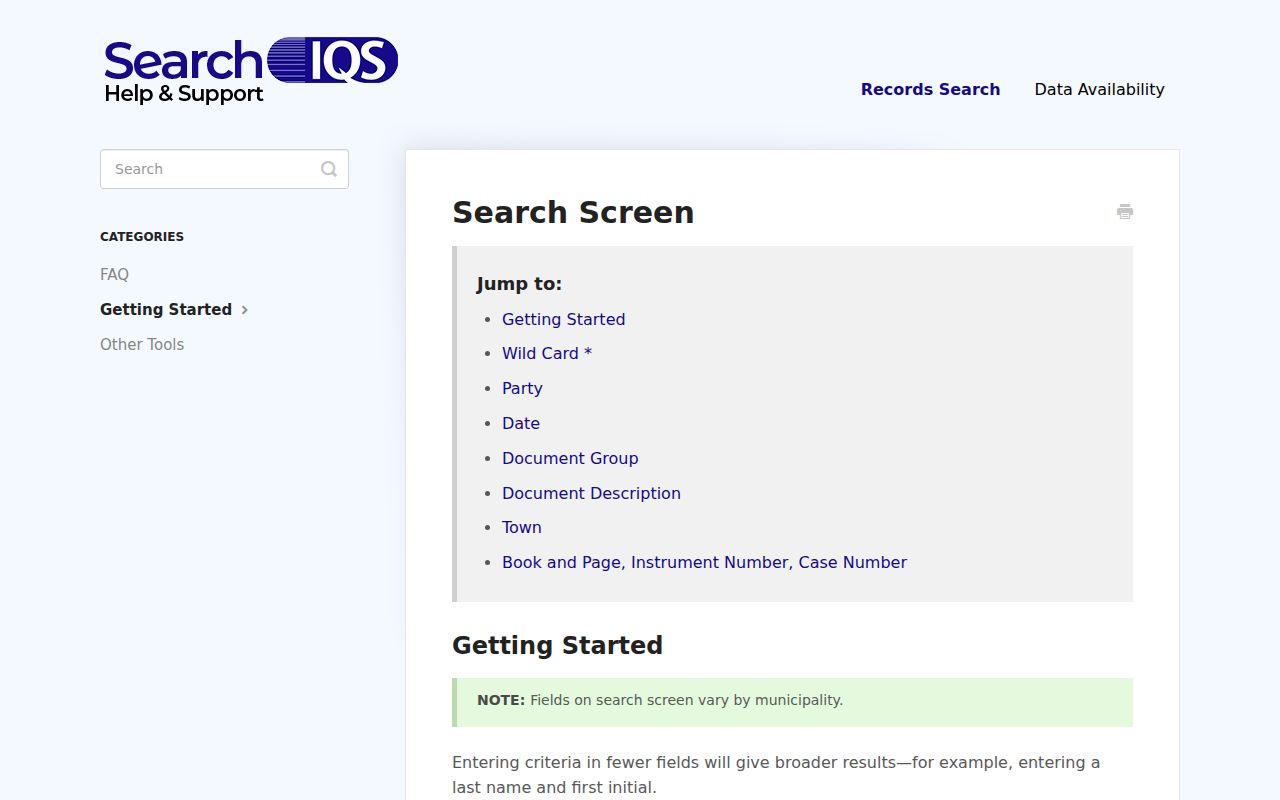
Confirm a party-name result against the instrument’s legal description and references. NYC uses its separate ACRIS route for four boroughs.
A practical chain search works backward from the latest deed. The current grantee becomes the next search name, and the prior deed’s grantor points to the previous transfer.
- Search the owner or parcel in the county index and locate the latest likely conveyance.
- Open the image or request it; note grantee, grantor, recording date, document type, legal description, and prior references.
- Search the prior grantor as a grantee, using a date range and the same municipality or parcel clues.
- Repeat until the county index reaches its stated boundary, then ask the clerk which books or older indexes cover the next period.
- Grantor
- The party named as transferring an interest in an instrument.
- Grantee
- The party named as receiving the interest.
- Chain of title
- The ordered record of conveyances tied to the same parcel description.
- Book/page or instrument number
- A clerk’s locator; county systems may use different reference formats.
Set the deed's legal description, municipality, and parties beside the tax roll or plat map. Prior references help too. A lot description may not repeat the street address. That is especially true after a subdivision, combination, or renumbering. The image is what verifies the land and interest the index entry describes. Skip it, and the record stays a guess.
Broome and Monroe Deed Indexes Split Coverage
Online date ranges are county facts, not statewide ones. Broome splits its current land records from older deed and index books. Monroe publishes different start dates for deeds, mortgages, lis pendens, discharges, and historical grantor-grantee indexes. One record class may be online. Another may sit in older volumes or a separate search. Check the county's coverage statement before widening a name search or ordering a copy. A hit in one index proves nothing about the parcel's other instruments. Saratoga and Monroe illustrate different local setups; they are examples, not a rule. The Monroe coverage page lists the separate record ranges in detail. Broome's own note explains its split between current and older books. Read the county's note before calling a blank query a historical gap.
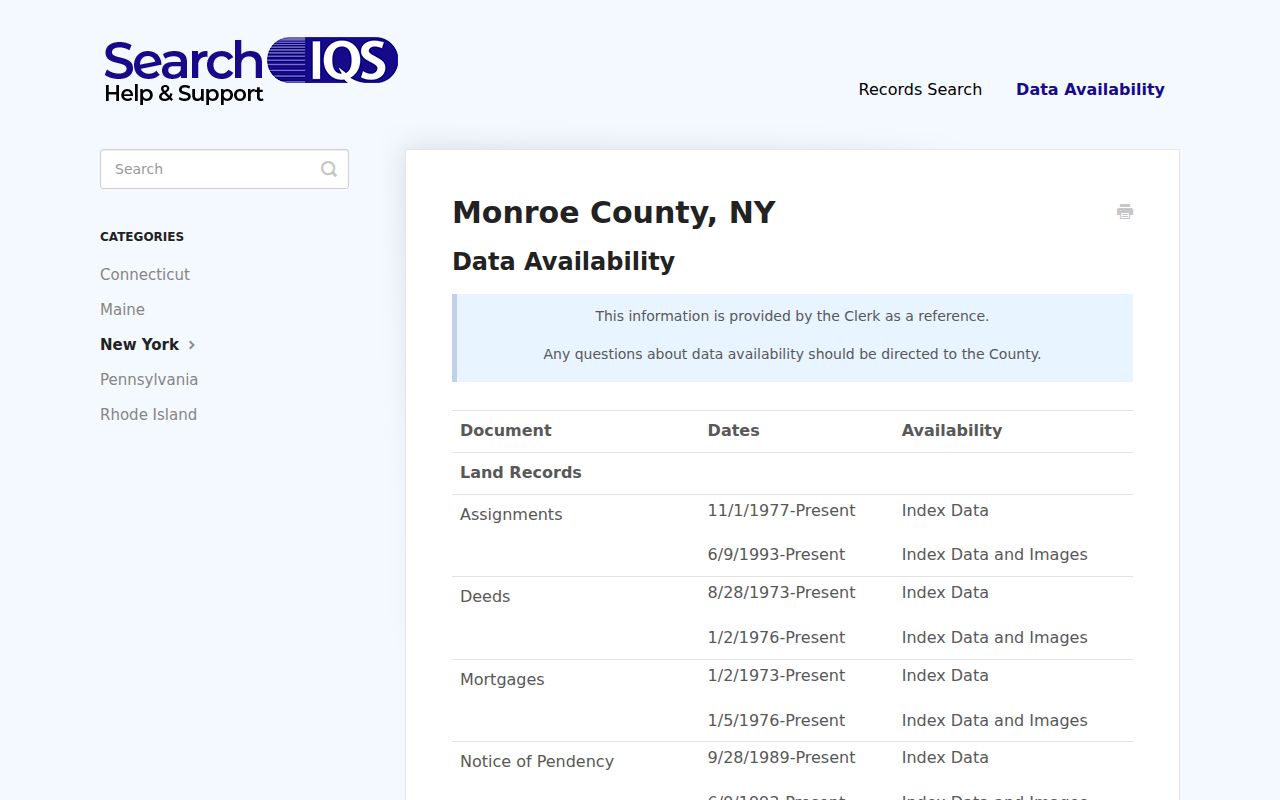
These county examples show why a coverage note belongs beside every search result: deed, mortgage, and older index dates rarely match one another in any county.
New York Deed Results Follow Transfer Dates
The deed and its RP-5217 transfer report go to the county clerk, which passes transfer data to the state and the local assessor. Sales Web draws on those local feeds, updates weekly, and can lag by weeks or months; it covers ten years outside NYC, so older transfers send you back to the county index. A tax roll owner of record can reflect the taxable-status date rather than a later deed, so compare deed, status, final-roll, and feed dates before calling any mismatch an error. Transfer categories complicate things too. A family transfer, partial interest, agricultural parcel, or new construction can make a price a poor open-market comparison. The RP-5217 guidance explains the data path. Remember that the form and the feed never replace the deed itself.
New York City Deed Records: Three Routes
Borough and document date decide where a deed lives. Manhattan, the Bronx, Brooklyn, and Queens record through ACRIS for documents from 1966 forward. Staten Island is different. Richmond County keeps its own records through the Richmond County Clerk. Before 1966, the other four boroughs send researchers to the Land Records Research Library. Some material sits in a borough office instead.
ACRIS searches by party, BBL, document type, document ID or CRFN. It also covers transaction number, reel and page, or UCC and federal-lien file number. The detail view may display a filing or cover page plus an image link. Keep your notes precise. Borough, BBL, recording reference, and result type belong together. A CRFN is not an upstate book/page citation. Read the ACRIS search help before picking a field. Its party and BBL controls work differently from the party fields in county SearchIQS forms.
That borough form is the first branch for four boroughs. Richmond and older records need their own custodian route. For a pre-1966 record, the New York City older-record instructions point to the Land Records Research Library and borough offices.
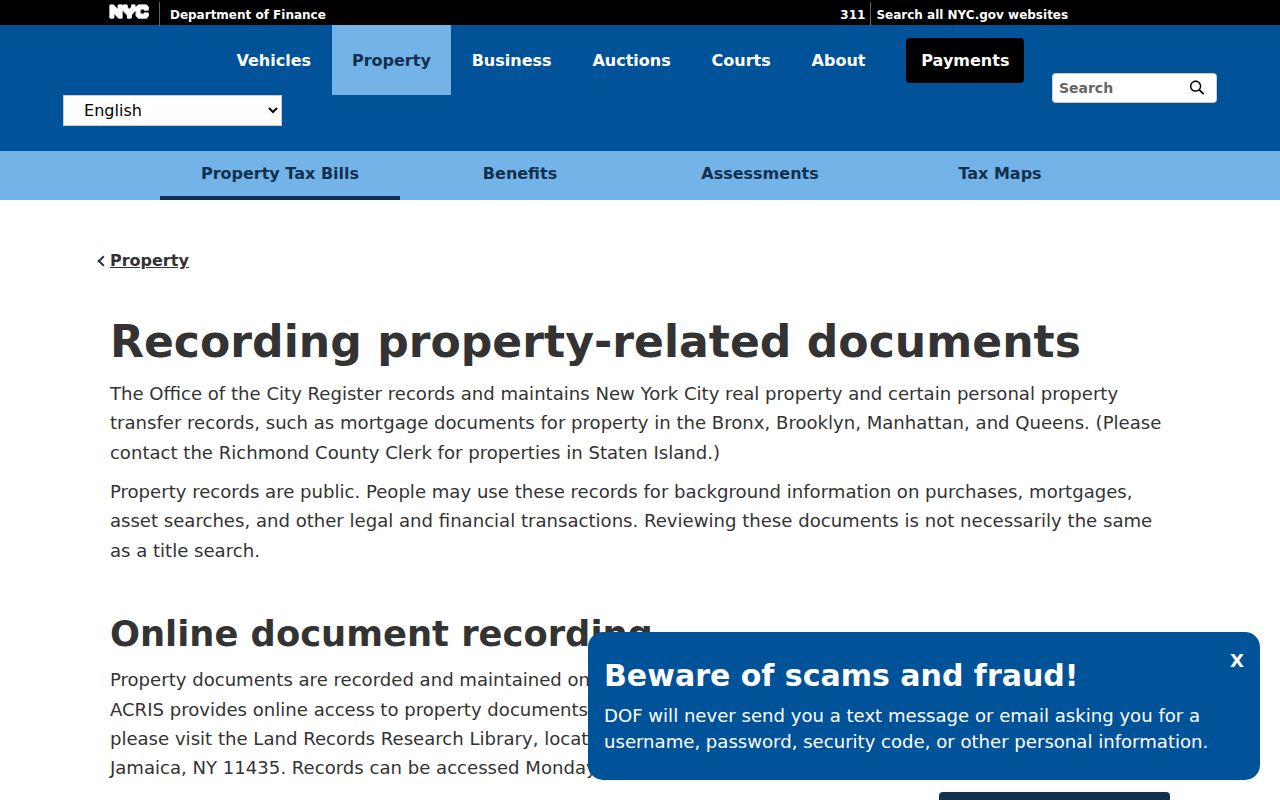
The older-record path matters because ACRIS covers a general span, not a complete historical index for every borough.
New York Historic Deeds Leave Online Indexes
The historic record trail predates modern county systems. The State Archives explains that most deeds after 1683 were recorded with county clerks. New counties were required to record deeds from 1794. Statewide recording took effect in 1823. Earlier colonial instruments may be unrecorded. So a portal's start date is an access boundary. It is not proof that an earlier deed never existed.
Work from the latest deed's prior references. Then ask the clerk which books and indexes cover the next period. Archives and microfilm routes vary by county and year. A research-room visit, mail request, or interlibrary loan may be needed. Note the county, town, series, reel, and page. Also note whether the source is an index or an image.
The Archives real-property pathfinder helps identify the next series when a county's online index ends.
Estate Deeds in New York Property Records
An estate inserts a court step into an ordinary property chain. Surrogate's Court records may show who held authority to act. The recorded fiduciary deed, or a later conveyance, shows how the land record actually changed. A probate docket is not a substitute for the recorded transfer. Likewise, a name in a will does not identify the parcel's later owner by itself.
For a historic family transfer, gather the county, the decedent, an approximate date, and the court file number if known. Compare the paper against the deed's parties, capacity, and legal description. Online case information may omit the papers, so ask the proper clerk for the file. Courts generally sit outside FOIL.
New York Deed Copies Vary by County
After an index hit, pull together the instrument number, book, and page. Also note the parties, date, and document type before asking for a copy. State whether you want an uncertified image or a certified copy. An image you open online is not automatically certified. The county may charge a fee or require an account.
Practices vary widely. Saratoga offers a free SearchIQS account plus in-person research. Monroe accepts written requests with separate search, per-page, and certification fees. It asks for index number, type, date, and parties. These are local examples, so confirm current terms with the holding county. A certified copy is authenticated by the custodian, unlike a viewable image. If an online image is missing, ask the clerk or use the mail route. See Saratoga County Clerk records for its online and office options. See Monroe County Clerk records for written request and fee details.
A suspicious deed calls for care. Preserve the recording date, reference, parcel key, and image. Then contact the recording office and consult the New York Attorney General's deed-theft guidance. Alert programs vary by county, and New York City also offers a recorded-document notification route.
Getting a New York Deed Copy
Once the right instrument is identified, follow the county's directions for viewing or ordering the record. A sample deed image can show the parties, recording date, book and page, transfer language, legal description, and prior-document references. Those fields let you check that the image matches the index result and the parcel under review.
| Deed Image Field | What It Shows |
|---|---|
| Grantor and grantee | Parties named in the instrument and any stated capacity. |
| Document type and transfer language | The record’s stated kind and the interest described. |
| Recording date and book/page | The clerk’s filing reference used to retrieve the instrument. |
| Legal description or lot detail | The land description that must be compared with the parcel. |
| Prior document references | Earlier instruments that may extend the chain. |
| Transfer-report material | RP-5217-related details where present in the source image. |
Recorded is not the same as guaranteed. A New York deed record shows an instrument filed in the named system; it is not a title opinion or proof that every interest has been found. Confirm the legal description and chain with the county custodian or a title professional.