
New York Property Value Types
New York property records answer value questions with several distinct amounts. The roll lays out the assessor's value, full market value, exemptions, and taxable value. A deed record may report the consideration paid. Name each measure and its year. Only then compare it against another parcel or sale. The table below ties each value type to the record where it usually lives.
| Value Type | What It Means | Where Recorded |
|---|---|---|
| Assessed value | Local assessment used to set the tax base | Municipal assessment roll |
| Full market value | Assessor’s estimate of the property’s full value | Roll field or local assessment record |
| Taxable value | Jurisdiction value after applicable exemptions | Roll fields for the taxing jurisdictions |
| Reported consideration | Amount reported for a recorded transfer | Deed, RP-5217, or sale-transfer record |
A taxable amount is not the tax bill. A reported transfer amount is not automatically a market benchmark. For any New York parcel, the municipality, roll year, and property class give a number its meaning. A deed may report a family transfer or a partial interest, and an assessment may rely on a local level of assessment rather than a recent sale price.
Find New York Assessed Value
Start with the local roll for an official assessed amount. New York keeps assessment at the municipal level. The roll's link may sit on a municipal page instead of one statewide search screen. Use the NYS Municipal Data Portal to pin down the county and municipality. Or follow the state's local assessment-roll instructions for the parcel you need. Remember that a postal city does not always match the assessing municipality. So confirm the jurisdiction before opening the roll.
- Use the Municipal Data Portal or local-roll instructions to confirm the county and assessing municipality.
- Select the city, town, or village and follow its assessment-roll link; retain the SWIS or TOV details used.
- Find the parcel by its tax-map key or accepted address, then note roll year, class, assessment, and full-value fields.
- Use a separate transfer source for sale consideration and retain its deed date and transfer category.
- Assessed value
- The local assessment entered for the parcel on a roll.
- Full market value
- The assessor’s estimate of full value, shown separately where the roll provides it.
- Taxable value
- A value after applicable exemptions, recorded by taxing jurisdiction.
- Level of assessment
- The ratio of assessed value to full value for the roll.
- Reassessment
- A municipality’s process of reviewing and setting assessments; timing varies by municipality.
- Sale consideration
- A transfer amount reported with a conveyance, which may need category and deed context.
New York Roll Value Fields
The NYS Open Data assessment dataset holds New York final-roll records. Local governments outside New York City submit them. Fields can include roll year, county and municipality, SWIS, and parcel address. Print key, owner, and mailing address can appear too. Property class, full market value, land and total assessment, exemption codes, and taxable value by jurisdiction round out the record. The state does not verify every local value. Treat the dataset as a discovery and comparison source. Then check the local roll for the municipality's own record of the parcel.
The official assessment-roll field guide explains SWIS and the taxable-status date. It also covers the valuation date, parcel key, class, exemptions, and both full and assessed value. The assessment dataset and its data dictionary lay out the field names and scope. The image shows parcel and roll identifiers next to the value fields.
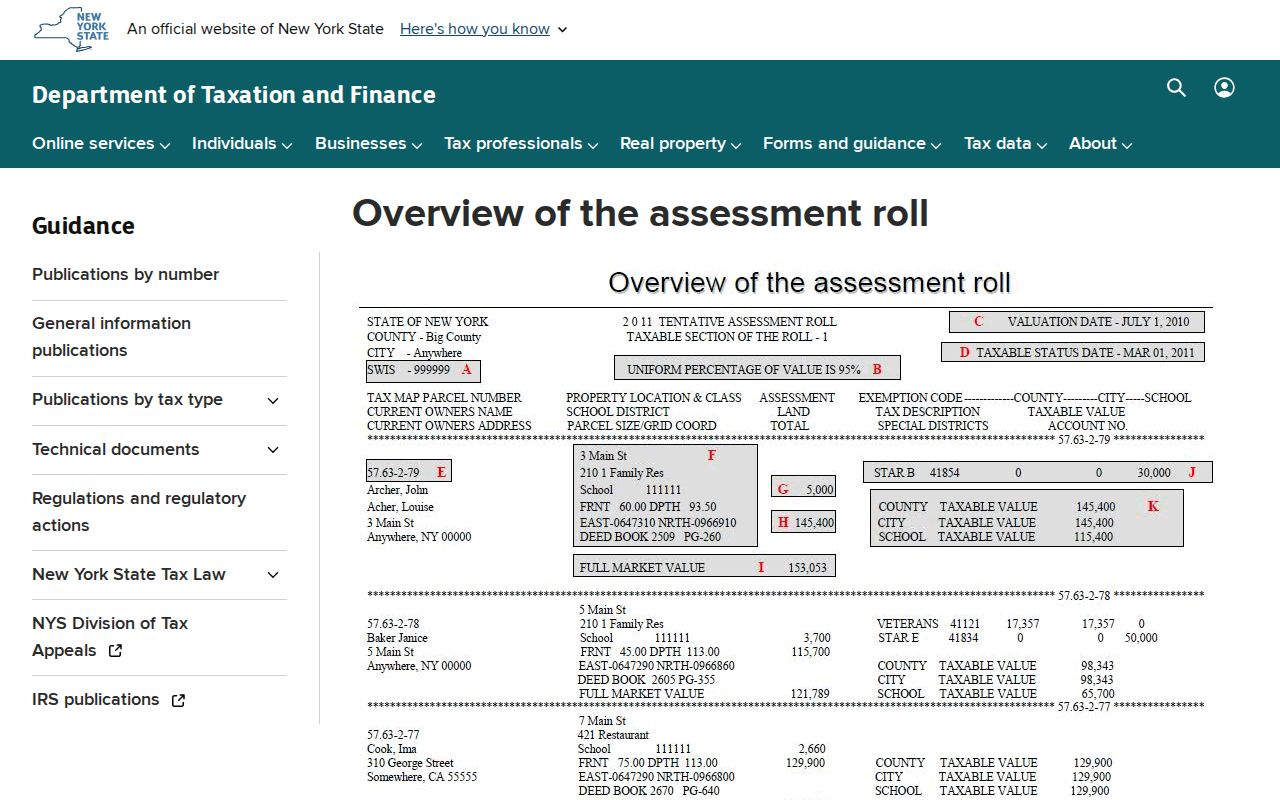
Use the key exactly as the local source shows it. The same parcel number may appear with different punctuation or a different label in a GIS map or clerk index.
New York LOA and Market Value
The level of assessment, or LOA, is a ratio. It compares a parcel's assessment to its full value. New York's Office of Real Property Tax Services states that where the LOA is not 100 percent, you can estimate market value. Divide the assessment by the LOA. As a formula: assessment ÷ LOA expressed as a decimal = estimated full market value. Use the New York percentage printed for the roll you are reading. Never borrow a ratio from another municipality. The state assessment guidance explains that calculation. It also shows how an assessment differs from a tax rate. Its page displays the LOA calculation in context. It is a method for reading the assessment record. It is not a private appraisal or a sale-price forecast.
Full market value remains a New York assessor's estimate tied to the valuation process. One municipality may assess at a different percentage than another. Raw assessment totals are therefore poor comparison points on their own.
New York Taxable Value
On a New York roll, taxable value follows the assessment and any applicable exemptions. A roll can show exemption codes or amounts for county, town, city, village, school, or special-district purposes. Read each code with the data dictionary and local roll. A code alone says nothing about eligibility, continued status, or the amount due. The taxable amount can differ by jurisdiction even for one parcel. Keep assessed value, exemption fields, and taxable value in separate notes. An exemption, class, assessment, or taxing district can change. That shift can move the taxable figure. No new sale is needed. The land itself may stay exactly the same. The tax bill adds its own rates, levies, credits, and payment rules, so it answers a different question. The New York property tax records page covers that bill and the related tax-record process.
New York Sale Values
Sales Web is the main state tool for tracking New York property values. It covers everything outside the five boroughs. It holds up to ten years of reported sales and transfers. You can search by buyer or seller, address, deed book and page, or tax-map ID. Local governments feed transfer data to the state on a weekly cycle. That means a recent deed may not appear for weeks or even months. For anything older than the ten-year window, go to the county clerk's deed index instead.
Treat every reported consideration with care. Not every amount reflects an arm's-length price. The RP-5217 form sorts transfers into categories. These include family sales, partial interests, agricultural parcels, and new construction. Read that category and the deed context before stacking one sale against another. The Sales Web description and RP-5217 transfer guidance explain how figures travel into local and state property records. They trace the path from the deed and transfer report.
New York City Property Values
New York City sits outside the statewide data picture. The Open Data roll and Sales Web routes skip the five boroughs entirely. The city relies on its own Department of Finance property data. Recorded deeds for Manhattan, the Bronx, Brooklyn, and Queens land in ACRIS. Richmond County records through the county clerk instead. Confirm the borough before matching a transfer to an assessment. The parcel identifiers must line up too.
The Department of Finance offers its own property assessment data route. ACRIS holds recorded documents for four boroughs. These systems are separate. Their dates can differ too. A borough record will never fit the upstate SWIS and print-key model. Don't force it.
Compare New York Property Values
Municipalities across New York revalue on their own schedules. The state's most recent reassessment table shows each town's timing. Use it as a reference. Never borrow one town's reassessment date for its neighbor. Assessors set values. Taxing jurisdictions set rates and levies. A changed assessment can stem from a new roll. It can also stem from a different class, an exemption, or parcel history rather than a matching price move.
A sound comparison takes work. Align roll year, municipality, tax class, LOA, and exemption status. Also check any split or combination in the parcel's history. Then check the sale against its transfer category and deed date. A public value pair missing those fields can make unlike records look alike. No statewide dataset produces a current market estimate for every New York parcel.
New York Value Limits
A New York assessment serves a tax purpose. The local roll and assessment level shape it. It will not tell you what a buyer would pay today, and the full market value field is not a private appraisal. A sale may be old, cover only a partial interest, or fall into a transfer category that makes it a weak comparison. Keep the source and date attached to every number. For a real valuation decision, use a qualified appraiser.
Assessment is not a price prediction. A New York assessed value is recorded for tax purposes. It is not an appraisal and does not predict the amount a property will sell for.
Treat assessed, full-market, taxable, and reported-sale figures as distinct evidence. A sale or financing decision needs a current professional valuation, not a relabeled public assessment.