
New York Roll Owner Fields
The local assessment roll is the natural first stop for a New York owner search. Its owner field carries the name tied to the roll's stated year and taxable-status date. Additional-owner and mailing fields may appear too. Neither promises a full legal vesting statement. The roll also does not refresh the moment a deed is recorded. The New York local roll route connects to the municipal officials behind these entries. It also carries the roll links.
| Field | What the Roll Shows |
|---|---|
| Owner name | First, middle, last, and suffix fields as submitted, where provided |
| Additional owner | Separate co-owner fields when the roll includes them |
| Mailing address | Mailing street and related address fields reported for notices |
| Situs or parcel address | The parcel location or address fields, which can differ from mailing |
| SWIS and print key/SBL | Municipality and parcel identifiers for matching the local record |
| Roll year and status date | The time frame attached to the assessment information |
| Deed book/page | A clerk-search lead when the roll row supplies a reference |
Treat "owner of record" literally here. It names whoever the roll lists for its own date, not a warranty against every current-title question. A deed reference is only a lead; the instrument and its parcel description still have to match before you rely on it.
New York Roll Dates and Owners
New York's property-tax calendar runs on a familiar rhythm. March 1 is the typical taxable-status date. May 1 brings the tentative roll. July 1 brings the final roll. A municipality's own roll notice controls its actual schedule, since local procedures vary. These milestones describe the assessment record, not a guaranteed posting date for each sale. The state property-tax calendar lays out the general sequence, though no universal closing-to-roll interval is published. That is why a New York current-owner result needs its roll year and date beside the name. The roll can be exactly right for its status date while a later conveyance lives only in the deed records.
New York Transfers after Status Date
Timing drives the rule. When a conveyance happens after the taxable-status date, the prior owner's name can stay on the roll for that cycle. The ORPTS opinion on RPTL §518 says as much. One date mismatch is explained this way. It sets no standard lag from closing to roll for every municipality.
Check the dates before calling a name field wrong. Match the recorded deed date against the roll's status date. If the deed falls later, treat the roll as showing the owner as of its own date. Rely on the deed records for the later conveyance. A New York owner of record can hold a deed that postdates the roll. A statewide transfer feed may also lag the underlying deed record. Its date deserves its own check.
Read New York Roll Owner Fields
The New York Open Data assessment catalog documents final-roll property records. Local governments file these records outside New York City. Each row can carry the owner of record plus additional owners. Mailing address parts, the parcel address, SWIS code, print key, and roll year also appear. That makes the catalog a handy key for decoding assessment data. The dataset page also lays out its scope and update controls. You can see exactly what the roll covers.
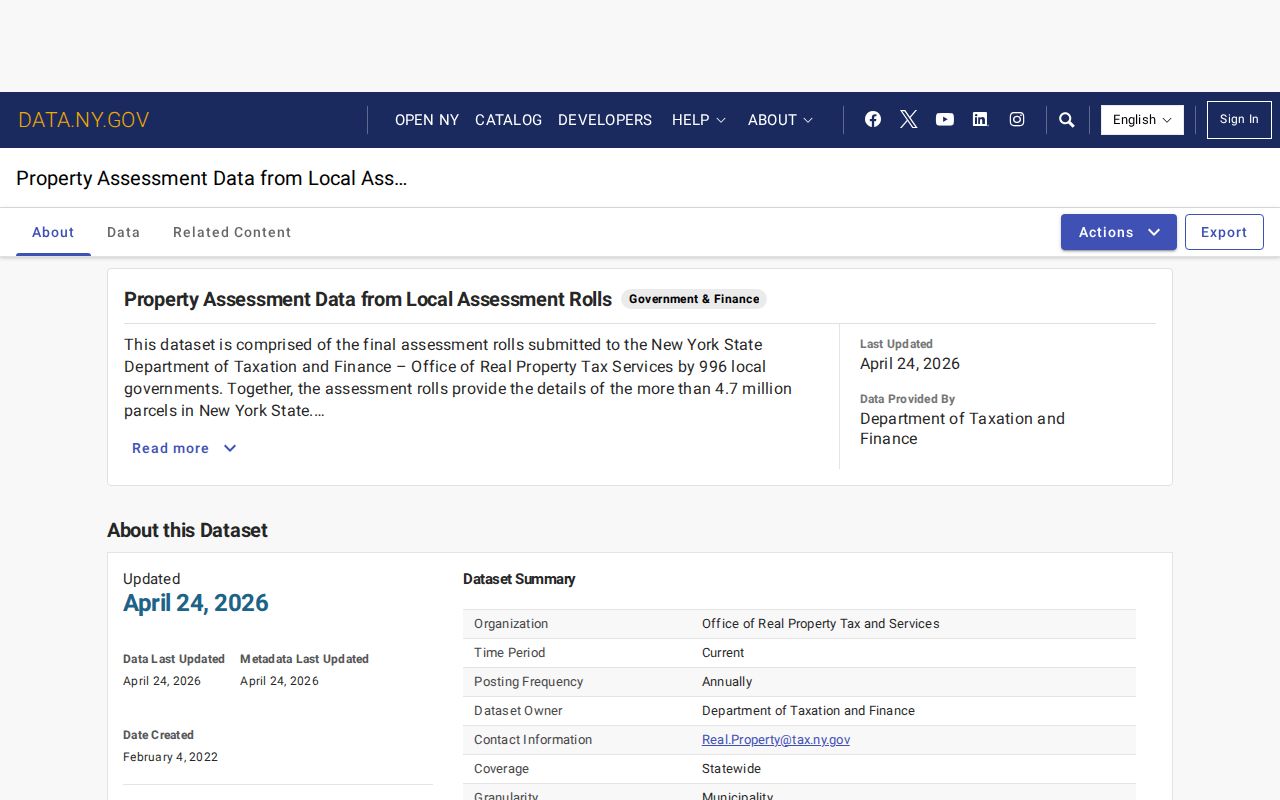
A current owner listed on any New York assessment roll deserves a second check. Compare the local roll date against the deed date before you rely on the name. This dataset skips New York City entirely, and it cannot substitute for a municipal correction or a county recording.
Confirm New York Owner by Deed Date
Keep the roll and the deed as separate entries. They agree only when the parcel identifiers match. Wait for that confirmation before merging your notes. The roll names whoever owned the parcel on its assessment date. For anything later, the most recent deed supplies the recorded parties plus the legal description. A transfer result or a map popup can point you toward the instrument. Only the deed itself settles the question of ownership.
- Open the local roll for the correct county and assessing municipality. Save its roll year, taxable-status date, SWIS, and print key/SBL.
- Search the appropriate transfer source for a later event: Sales Web outside NYC, or the correct New York City recording route.
- Use the county clerk index, reached through NYS Land Records, or the register system to obtain the latest deed or instrument image, with its recording date and number.
- Compare the named party, capacity, and legal description with the parcel key. Keep a mismatch marked by source and date until the custodian resolves it.
- Owner of record
- The party named in a particular assessment roll for its own year and status date.
- Assessment roll
- The local valuation and tax-base record for a stated roll cycle.
- Situs and mailing
- Situs is the parcel location; mailing is where the roll directs notices.
- Recorded deed
- An instrument filed with the recording office; its parties and legal description need to match the parcel.
To trace an owner from a street address, follow the New York ownership lookup route. It explains the method and why each source tells a slightly different story. Whatever you pull, the current-owner record stays anchored to its stated roll date.
New York Mailing and Situs
A roll’s mailing address shows where assessment notices go. That is its only job. It may not name the parcel’s municipality. It may not be the owner’s residence either. In New York, a postal city often differs from the town, city, or village. That municipality is what actually assesses the parcel. School, village, and other tax districts can pile still more labels onto the same location. Use the Municipal Data Portal with the roll’s SWIS and print key. That pins down the assessing jurisdiction. Then match the situs or parcel address to the map and deed. Only after that should a mailing field count as part of the property description.
New York Entity Ownership Has Limits
New York tax rolls often carry an LLC, trust, estate, trustee, or executor instead of a person's name. That entry reflects whoever was submitted for the record. It does not prove who holds the parcel now. Nor does an entity's status or registered-agent field reveal every person with an interest in the property. Entity records simply do not map every interest.
The NYS Department of State entity database covers organization, jurisdiction, service-of-process, and filing details. Its history runs thin for some older or inactive entities. Check the entity name and capacity against the recorded deed itself. When an estate shows up, the county Surrogate's Court can clarify who holds authority. The deed still stands as the true property-transfer record.
New York City Owner Records by Borough
Four of the five boroughs, Manhattan, the Bronx, Brooklyn, and Queens, share one recording system. That system is ACRIS, and it generally covers recorded documents from 1966 forward. City searches lean on borough, block, and lot identifiers as well as party names. Staten Island is different. Recording there runs through the Richmond County Clerk. Pre-1966 city documents follow the Land Records Research Library and borough-office route.
So a current-owner check in New York City needs two things: the borough and that record system's own identifier. Don't force an upstate SWIS or print-key format onto a BBL. And don't read an ACRIS summary as the full instrument. Open the document image and match its parcel reference.
New York Owner Date Card
New York sources often disagree about an owner's name, and a date card explains why without declaring one source wrong. Keep it simple. Line up the roll date, the deed date, and the map or attribute date beside the same parcel key. Note the date you searched, too. That way the whole comparison can be repeated later.
| Date to Save | What It Labels |
|---|---|
| Roll year and taxable-status date | The New York assessment owner field’s time reference |
| Deed recording date | The filed conveyance date shown by the clerk or register |
| Map or attribute update date | The geometry or roll year attached to a GIS result |
| Search date | When the current source result is checked |
Keep the source URL and county next to each date. The current owner field in New York is not a live tax-bill ledger. A map can even carry geometry and owner attributes from different periods, so the pairing matters.
New York Owner Address Limits
Public owner fields answer a property question. They do not build a personal profile. Keep the parcel address, the roll year, and the official source together as one bundle. Never assume a tax mailing address is someone's home address. New York's Address Confidentiality Program gives eligible participants a substitute Albany mailing address in covered government records. It does not erase older records.
The roll can lag a later conveyance. No universal New York closing-to-roll update interval is published. When the latest deed has a recording date after the roll’s status date, that deed is the more current public record of the transfer, subject to matching the parcel and parties.
Respect any substitute address you encounter. Skip republishing unrelated personal details. If the roll and the deed disagree, keep both dates and ask the local assessor or recording office which source controls the field in question.
Requesting a New York Roll or Deed
Not every roll or instrument image is online. When it isn't, ask the municipality's assessor or county clerk about the public counter. Ask also about the online index, mail requests, or copy procedures. Give them everything useful: county, municipality, roll year or date range, parcel key, party name. Include any book/page or instrument number. Ask what you'll actually get back. It may be an index entry, an image, or a certified copy. Fees and turnaround vary by county.
For an existing assessment record at a covered agency, a focused request can go to that agency's Records Access Officer under New York FOIL. The same works for a mapping record. Wait, correct that: the law lives at New York FOIL. FOIL does not force an agency to build a new owner report. Court records take a separate clerk route. In the end, the current owner is a conclusion drawn from named sources and dates. That is not a promise of a statewide live registry.
The New York deed-record route covers recorded instruments in more detail.